
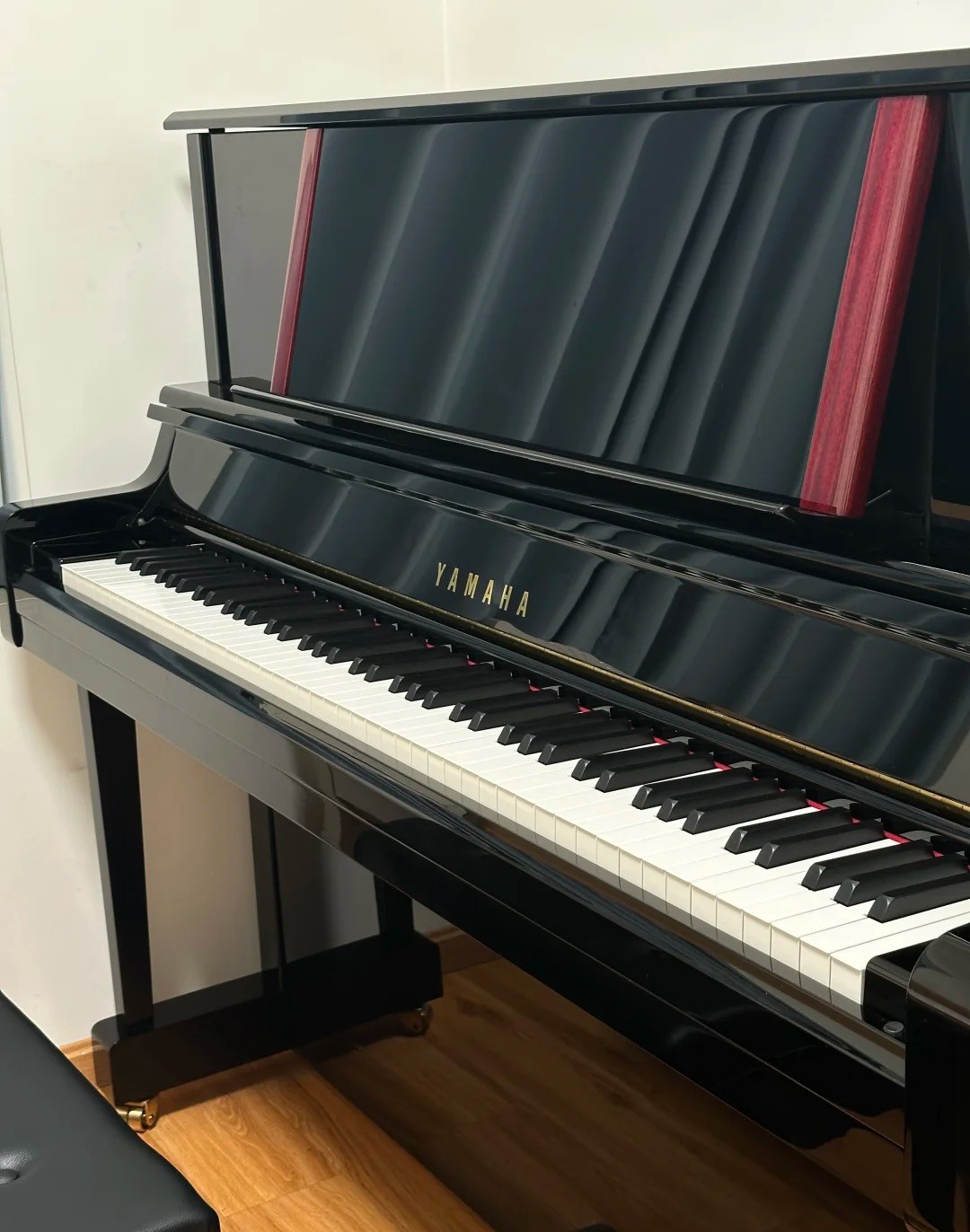
The Yamaha U1 (121 cm) is the absolute reference among acoustic uprights: legendary reliability, consistent tone and unmatched resale value. It is the “safe choice” that always sells well.
Who is it for?
For an intermediate-to-advanced pianist, a music school or a family investing for the long term — reliability and durability first.
The tone
At 121 cm the U1 gives what its reputation promises: a consistent, well-balanced voice that suits almost any repertoire. It is neither the warmest nor the darkest upright on the market — Yamaha’s signature carries a degree of brightness and projection — but that very clarity is what makes it so versatile across classical, pop and jazz. Crucially, it is predictable: a U1 in one showroom sounds much like a U1 in another, a consistency that decades of refined production have made its calling card.
The action
The U1’s action is a study in reliability. It has changed little in half a century, and that continuity is a feature, not a limitation: technicians know it intimately, parts are universally available, and it holds regulation well. For a music school putting an instrument through thousands of hours a year, or a family investing for the long term, that durability is worth as much as any tonal nuance.
Resale value: the decisive argument
No other upright holds its value like the U1. A vast, liquid second-hand market — built on fifty years of steady output — means a well-kept U1 sells readily and predictably. That changes the economics of ownership entirely: the real cost over a decade is far lower than the sticker price suggests, because the instrument can be sold on with confidence. It is the “safe choice” precisely because the exit is as easy as the entry.
Reliability and longevity
U1s routinely serve for decades and pass through several owners. Kept in a stable environment and tuned regularly, the instrument ages gracefully, and any competent technician can maintain it. This combination of durability and universal serviceability is why the U1 is so often the default recommendation for a long-term acoustic purchase.
Who it suits
The U1 is aimed at the intermediate-to-advanced pianist, the teaching studio or the family investing for the long haul. Buyers chasing the last degree of tonal character may prefer a rival with more warmth, but few instruments match the U1’s blend of consistency, reliability and resale security.
Frequently asked questions
Why is the U1 so often recommended? For its consistency, its proven reliability and its unmatched resale value, which together make it a low-risk long-term purchase.
Is a new U1 worth it over a used one? A well-maintained used U1 is one of the market’s safest buys; the choice comes down to budget, condition and how the specific instrument has been kept.
Placement and long-term care
Much of what a U1 delivers over the years depends on how it is kept. Place it against an interior wall, away from radiators, direct sun and draughts, and watch room humidity across the seasons: the U1’s celebrated stability still rests on a sensible environment. Tuned once or twice a year and regulated periodically, it holds its consistency for decades and remains serviceable by any competent technician. This ease of upkeep is part of why the second-hand market trusts it so completely — a well-documented service history only strengthens its already strong resale position when the time comes to move it on.
Are silent or hybrid versions worth considering? If night practice matters, Yamaha’s silent-equipped uprights add headphone play to the same acoustic; otherwise the standard U1 remains the reference for reliability and resale.
Our upright piano reviews
Compare our acoustic upright reviews rated with the Diapason method:
Field feedback: Yamaha U1 vs Kawai K-300: what owners actually say.
→ See all our Diapason ratings
🎹 Essential accessories for pianists
Where to buy : Yamaha U1
| Retailer | Why | |
|---|---|---|
| Thomann | Reference price, specialist dealer, warranty | See prices on Thomann → |
| Amazon | Fast shipping, used and renewed units | See on Amazon → |
Affiliate links: the price is the same for you, the commission funds our tests. As an Amazon Associate we earn from qualifying purchases.
This page contains affiliate links. If you buy through them, we may earn a commission at no extra cost to you.
- Adjustable piano bench: Thomann KB-15BM
- LED piano lamp: Thomann PLL24 LED
- Felt key cover: Jahn Keyboard Dust Cover
- Thermo-hygrometer (humidity): TFA Digital Thermo-Hygrometer