
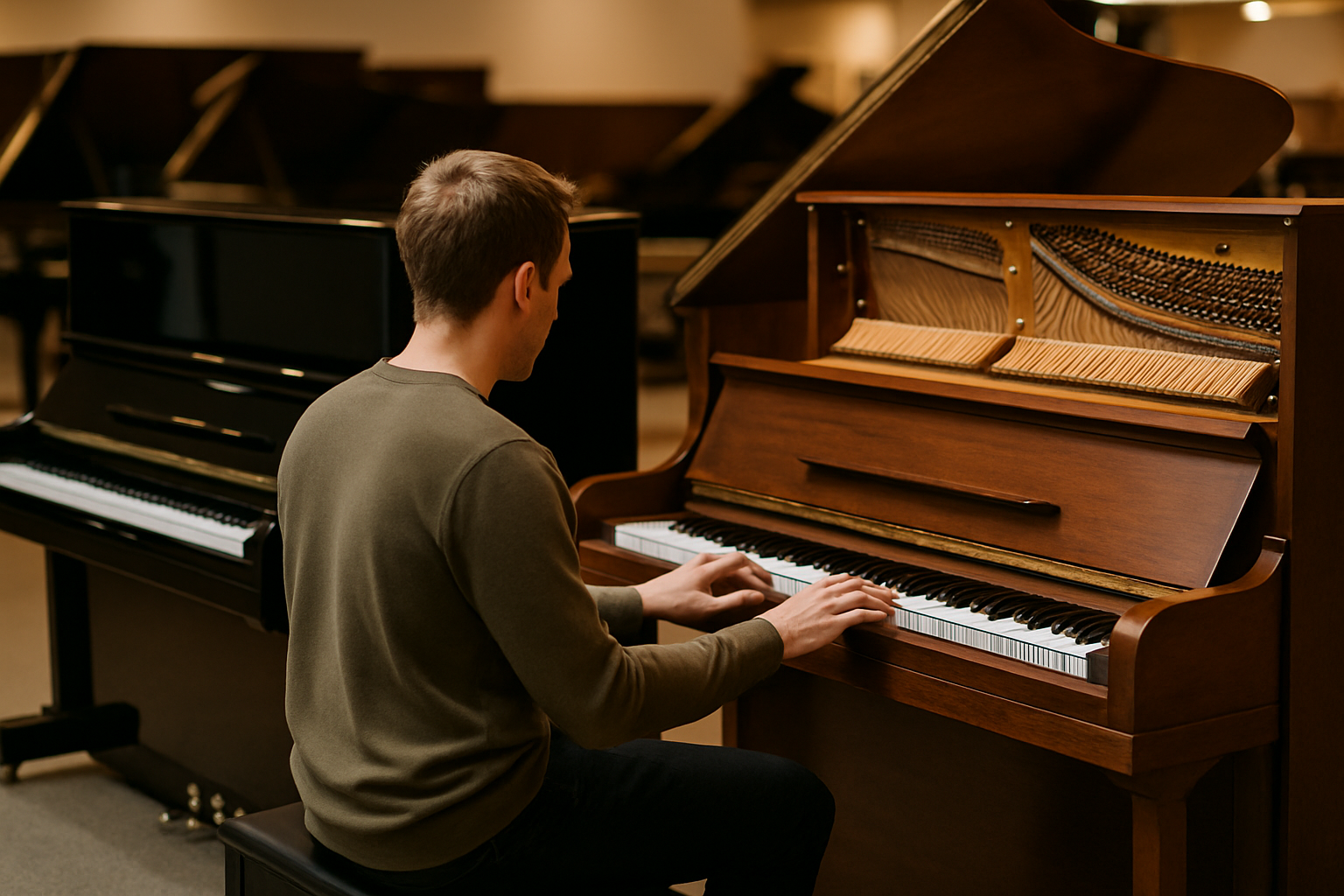
It is probably the most debated upright duel on pianist forums: Yamaha U1 versus Kawai K-300. Rather than repeating spec sheets, we went through the threads where owners and technicians describe how these two uprights behave in real use — a useful companion to our upcoming U1 review and K-300 review.
The tonal divide: brightness versus warmth
The threads agree on one thing: these pianos have different characters. A K-500 owner (same action family as the K-300) describes an “extremely responsive” touch and a warm voice, while U1s “tend to sound brighter”. Another contributor maps this onto repertoire — Yamaha’s bite suiting pop and jazz, Kawai’s rounder character suiting classical players. A third pushes back against the stereotype: tone “is not fixed”, and a good technician’s voicing narrows the gap considerably.
Action: carbon fibre versus tradition
The thread’s author perceived the Kawai action as lighter — an advantage, in his view, for Chopin. The K-300’s carbon-fibre components against Yamaha’s more traditional action crystallise the innovation-versus-continuity debate: one member defends the U1’s fifty-year consistency as documented reliability, another counters that Kawai’s frequent revisions are continuous improvement, not instability. Notably, a registered piano technician (RPT) in the thread praised the K-300’s factory V-bar shaping as superior — the kind of detail only a teardown reveals.
Money matters
Owner feedback confirms an asymmetry worth knowing: the K-300 is usually cheaper to buy, the U1 holds its value better on the second-hand market. Warranties differ too — 10 years for Kawai against 5 for Yamaha, a point raised repeatedly. And check the origin of the specific instrument: depending on the market, Indonesian-built K-300s coexist with Japanese-built ones at different prices.
The takeaway
The forum split is close to 50/50, and that is the honest conclusion: there is no objective winner, only two signatures. Play both back to back in the same room — and see our Yamaha range guide for how the brand’s voicing philosophy carries across the catalogue.
Two signatures, one way to choose
The near-even forum split is not indecision: it signals that the U1 and K-300 do not compete on the same ground. One offers a brighter, more projecting voice; the other a rounder character on an action many find slightly lighter. Neither is “better” in the abstract; the better one is whichever matches your repertoire and your ear. That is why, on the objective criteria, our grid separates tone, action and finish rather than hunting for a single winner.
A showroom checklist
From this feedback we draw a few practical reflexes. Play the two instruments in the same room and back to back, not days apart, because tonal memory is short. Ask when the showroom example was last tuned and voiced: a neglected upright skews the judgement. Check the production origin, which can vary on the K-300, and compare the warranties, which differ between the makers. And if you can, listen with the lid closed too — that is how the piano will actually sound in your home.
The resale factor
A final element, often decisive, concerns value over time. The U1 enjoys a broad, liquid second-hand market: half a century of steady production has made it a benchmark, and it resells readily and at predictable prices. The K-300, excellent as it is, relies on a shallower used market and a slightly steeper depreciation from new. This is not a verdict on quality but an economic fact to weigh, especially if you might sell the instrument within a few years or are buying with an eye on how well the outlay holds its value.
A note on method
This article synthesises public exchanges between pianists, owners and technicians on specialist forums (PianoWorld in particular), consulted in June 2026. Comments are paraphrased — never reproduced verbatim — and remain the opinions of their authors. We cross-check them against our own evaluation grid without conflating the two: our rating method documents our criteria.
Threads consulted:
This page contains affiliate links. If you buy through them, we may earn a commission at no extra cost to you.
🎹 Essential accessories for pianists
This page contains affiliate links. If you buy through them, we may earn a commission at no extra cost to you.
- Adjustable piano bench: Thomann KB-15BM
- LED piano lamp: Thomann PLL24 LED
- Felt key cover: Jahn Keyboard Dust Cover
- Thermo-hygrometer (humidity): TFA Digital Thermo-Hygrometer