
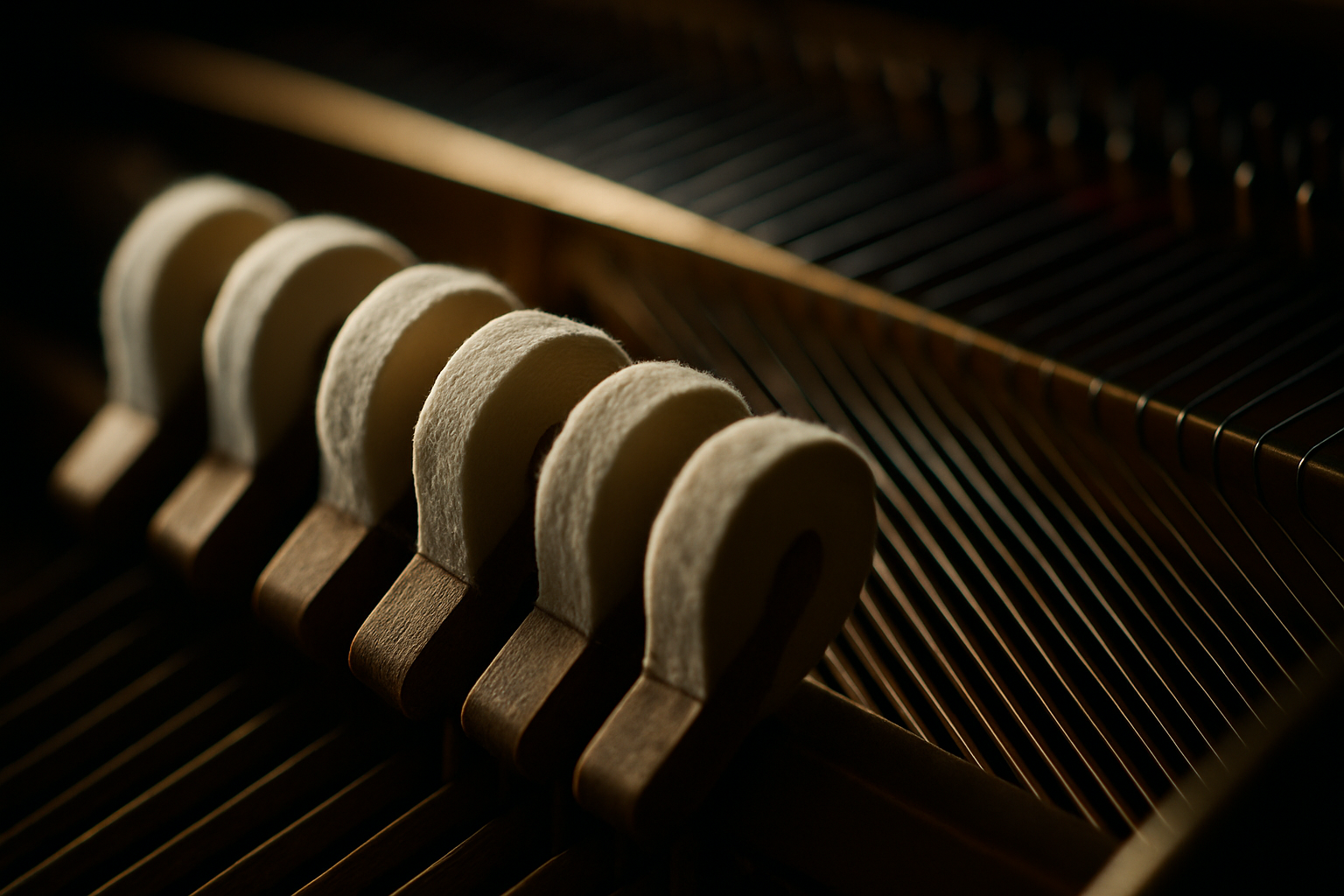
You cannot read three forum threads about Yamaha without meeting the word “bright”. The reputation — a compliment to some, a deal-breaker to others — deserves better than a cliché: the technicians who actually open these pianos debate it with real arguments. A useful read before buying anything from a baby grand to a CX.
Why the reputation is not a myth
Material explanations exist. A piano maker points to thick, heavy soundboards that take energy to move — pushing the factory towards more aggressive voicing, which hardens further with playing hours. A registered technician confirms the history: 1980s Yamaha hammers were “relatively hard and bright” from the factory. The reputation was built on something real.
Why it is largely fixable
The technicians’ counter-argument is just as concrete: most pianos leave the factory bright and are meant to be voiced down — and “Yamahas voice quite well”. One member reports that even a ten-minute voicing noticeably reduces harshness; for stubborn cases the options escalate from needling the felts to third-party hammers (several references cited) that hold a mellower voicing over time. In short: if a Yamaha wins you over on everything except brightness, that parameter is negotiable — price the voicing with your technician before walking away.
And what if brightness were a feature?
A dissenting voice in the thread makes a fair point: that piercing projection has a function. In ensembles, churches, classrooms or unamplified stages, a piano that cuts through gets heard — a design choice more than a flaw. It is also why recent generations have softened without renouncing it: a pianist-dealer observes that “the newer Yamahas are getting less bright, while the newer Steinways more bright”. The lines are moving.
The takeaway
Three buyer reflexes: judge the example, not the brand; listen in your target acoustics, not a treated showroom; and budget for custom voicing. Our Yamaha vs Steinway comparison returns to these tonal signatures model by model.
How a Yamaha is mellowed
The most useful technical point from these discussions is that brightness is largely negotiable. Most pianos leave the factory voiced bright and are meant to be softened, and Yamahas take to that work well. The options scale by intensity: from simply needling the hammer felts — sometimes a few minutes noticeably reduce harshness — through to fitting third-party hammers that hold a mellower voicing over time in stubborn cases. If a Yamaha wins you over on everything but brightness, price the voicing with your technician before walking away.
Brightness and the room
A common error is judging brightness in an acoustically treated showroom, then finding a different sound at home. A room with hard surfaces and little furniture exaggerates the treble; rugs, curtains and bookshelves soften it. Before condemning — or praising — a piano’s voice, picture it in your target acoustics. And remember that the piercing projection so often debated is a virtue in ensembles, churches and on unamplified stages, where an instrument that cuts through gets heard.
Recent generations are moving
It is worth remembering that the brightness reputation refers largely to instruments from some decades ago. The more recent generations, with the CX series to the fore, have worked on exactly this trait, softening the character without giving up the projection that remains part of the brand’s identity. One pianist-dealer even observes that the lines are converging, with recent Yamahas less bright and some Steinways rather more incisive than before. The moral: judge the instrument in front of you, not the reputation of its family, and take the year of manufacture into account when reading second-hand opinions.
A note on method
This article synthesises public exchanges between pianists, owners and technicians on specialist forums (PianoWorld in particular), consulted in June 2026. Comments are paraphrased — never reproduced verbatim — and remain the opinions of their authors. We cross-check them against our own evaluation grid without conflating the two: our rating method documents our criteria.
Threads consulted:
- Yamahas are considered bright… why? — PianoWorld
- Yamahas: are they really “too bright” — PianoWorld
- Yamaha C3X worth it? — PianoWorld
This page contains affiliate links. If you buy through them, we may earn a commission at no extra cost to you.
🎹 Essential accessories for pianists
This page contains affiliate links. If you buy through them, we may earn a commission at no extra cost to you.
- Thermo-hygrometer (humidity): TFA Digital Thermo-Hygrometer
- Caster cup (sold singly): Jahn IsoFloor
- Felt key cover: Jahn Keyboard Dust Cover
- Adjustable piano bench: Thomann KB-15BM